The Servile Mind: How Democracy Erodes the Moral Life by Kenneth Minogue
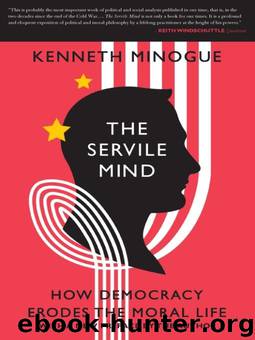
Author:Kenneth Minogue [Minogue, Kenneth]
Language: eng
Format: epub, mobi
ISBN: 9781594036514
Publisher: Encounter Books
Published: 2012-11-19T22:00:00+00:00
8. CONFLICT, BALANCE, AND THE WEST
Let us now widen the focus and locate individualism and the moral life within broader issues in the character of our civilization. And we may take our clue about this from our sketch of the moral life itself. “Doing the right thing” turned out to involve two elements, those of act, and those of motive. Starting from a single idea, we found ourselves with a duality. And if we extend the context of this observation, we shall be struck, I think, that the duality merely reflects the Christian distinction between Caesar and God. Order is the business of authority, goodness the business of spirituality and the inner life. We have not here stumbled upon a pure point of origin, of course, because we might trace this distinction back both to the constitutional practices of the Romans and the philosophical disputes of the Greeks. The drive in most human life is to find some basic principle that will satisfy all demands, and yet our imperfections tell us we have not found it. We may yearn for a single coherent harmony of things in the world, but something in the practice of European life, especially in the modern world, prevents our achieving it. Instead of harmony, we find conflict. This is to restate the problem of the early modern skeptics, and we may ask, as they did, is this a misfortune?
From this perspective, European history is a graveyard of grand projects of intellectual and political union. Both papacy and empire overreached themselves in medieval times, and more recently hegemonic ambitions afflicted Hapsburg, Bourbon, and Bonapartist. They all failed. The Prussians and the Nazis have been the most recent powers attempting to turn Europe (and indeed the world) into a single entity. And the Nazi case is instructive because it was based upon a project of ordering the world in terms of comprehensive notional superiorities of race. Communism is another typically ideological project for creating a single world community in which everybody lives the right way of life. Nationalists have also often had such transcending ambitions. Christians sometimes dream of reconciliation of all the faiths, but for rip-roaring religious monism these days, one must go to the Islamist project of uniting us all in submission to Allah and Sharia law. In all of these cases, the project depends on the idea that there is a single right way of life we all ought to be living.
Europeans have turned out to be profoundly unsuitable material for grandiose unifications of this kind. And here we face one more version of that interesting criticism of individualism that has long been a standard topos in our European self-understanding: namely, that taken abstractly, the individualist moral life would seem to be so destructive of peace and order as to be on the verge of collapse. The much-hated thing called “capitalism” is always generating crises that encourage its enemies to hope that the end is near, but they suffer endless disappointment. Individualist societies have turned out, in fact, to be astonishingly stable.
Download
The Servile Mind: How Democracy Erodes the Moral Life by Kenneth Minogue.mobi
This site does not store any files on its server. We only index and link to content provided by other sites. Please contact the content providers to delete copyright contents if any and email us, we'll remove relevant links or contents immediately.
| Anthropology | Archaeology |
| Philosophy | Politics & Government |
| Social Sciences | Sociology |
| Women's Studies |
The Secret History by Donna Tartt(19103)
The Social Justice Warrior Handbook by Lisa De Pasquale(12197)
Thirteen Reasons Why by Jay Asher(8919)
This Is How You Lose Her by Junot Diaz(6894)
Weapons of Math Destruction by Cathy O'Neil(6285)
Zero to One by Peter Thiel(5808)
Beartown by Fredrik Backman(5768)
The Myth of the Strong Leader by Archie Brown(5513)
The Fire Next Time by James Baldwin(5454)
How Democracies Die by Steven Levitsky & Daniel Ziblatt(5225)
Promise Me, Dad by Joe Biden(5157)
Stone's Rules by Roger Stone(5091)
A Higher Loyalty: Truth, Lies, and Leadership by James Comey(4967)
100 Deadly Skills by Clint Emerson(4932)
Rise and Kill First by Ronen Bergman(4797)
Secrecy World by Jake Bernstein(4756)
The David Icke Guide to the Global Conspiracy (and how to end it) by David Icke(4724)
The Farm by Tom Rob Smith(4517)
The Doomsday Machine by Daniel Ellsberg(4493)
